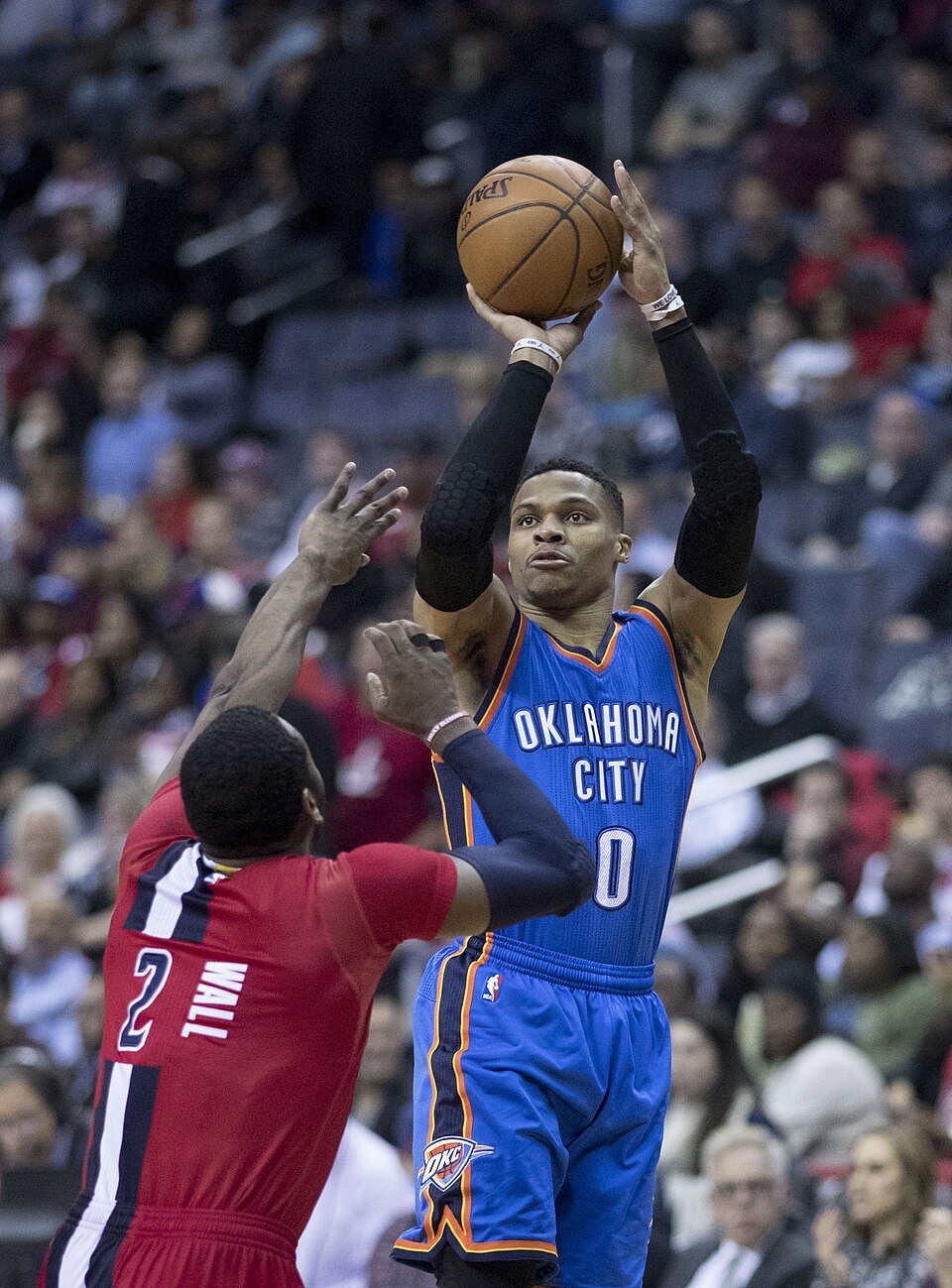
Russell Westbrook has announced his retirement from the NBA after 18 seasons.
The 37-year-old ends his career as the NBA's all-time leader with 209 triple-doubles after spending his final season with the Sacramento Kings.
Westbrook was named NBA MVP in 2017, earned nine All-Star and nine All-NBA selections and won two scoring titles during a career that began when he was selected fourth overall in the 2008 NBA Draft.
He spent his first 11 seasons with the Oklahoma City Thunder before later playing for Houston, Washington, the Los Angeles Lakers, LA Clippers, Denver and Sacramento.
Lean Edge Thoughts...
Russell Westbrook's career will probably be debated for as long as people talk about basketball.
That feels appropriate.
Few players have ever made the sport look quite like Westbrook did.
At his peak, every possession seemed to happen at maximum speed. He attacked the basket, rebounded among much bigger players and turned defensive possessions into fast breaks before opponents had time to organise.
Then there were the triple-doubles.
For decades, Oscar Robertson's achievement of averaging a triple-double across an entire season had existed almost as a statistical relic.
Westbrook did it in 2016-17.
Then he did it three more times.
His MVP season remains extraordinary: 31.6 points, 10.7 rebounds and 10.4 assists per game while carrying Oklahoma City through its first season following Kevin Durant's departure.
Westbrook finished that season with 42 triple-doubles, breaking Robertson's single-season record.
He retires with 209.
That number will inevitably dominate the statistical summary of his career.
But reducing Westbrook to triple-doubles misses much of what made him important.
He became the identity of basketball in Oklahoma City.
Kevin Durant was the more efficient scorer. James Harden eventually became an MVP elsewhere.
Westbrook was the player who stayed.
After Durant left for Golden State in 2016, Westbrook could have decided his own future belonged somewhere else.
Instead, he signed a new contract with Oklahoma City and produced the most celebrated individual season in franchise history.
That relationship with the city became part of his legacy.
There is another side to the discussion.
Westbrook never won an NBA championship.
His shooting efficiency became an increasing problem as the league moved further towards spacing and three-point shooting.
His decision-making could be chaotic.
And the later stages of his career, particularly his time with the Lakers, exposed how difficult it could be to fit a declining version of Westbrook around other ball-dominant stars.
Those criticisms are legitimate.
They also should not erase what came before them.
Prime Westbrook was not merely collecting rebounds to complete triple-doubles.
He was one of the most destructive transition players basketball has seen.
He won two scoring titles.
He became an elite playmaker and finishes his career fifth on the NBA's all-time assists list.
He made nine All-NBA teams.
And at 6-foot-3, he somehow turned rebounding into one of the defining characteristics of his game.
Even the end of his career says something about him.
Westbrook started 58 games for Sacramento in his final season and was still contributing rather than hanging around simply to extend his career.
He had opportunities to continue playing.
He chose to stop.
That means there will be no championship ring added at the end of the résumé.
There does not need to be.
Championships matter enormously when comparing careers, but basketball history becomes rather dull if every great player is reduced to the number of rings beside his name.
Westbrook gave the NBA something considerably harder to quantify.
He gave it a style that was unmistakably his.
You could watch five seconds of Russell Westbrook playing basketball and know exactly who you were watching.
Not many players can say that.
LEAN EDGE VERDICT: Russell Westbrook's career was imperfect, spectacular and completely unforgettable. The 209 triple-doubles will sit at the top of his statistical legacy, but they are not the reason he mattered. Westbrook played basketball with an intensity that turned an entire franchise into an extension of his personality and forced the league to reconsider what a point guard could produce. He retires without a championship, but with an MVP, records that once looked impossible and a place among the defining players of his generation. That is more than enough.